
Buzz and Bite
MALARIA
Buzz and Bite
Objective
To prevent malaria infection by turning a simple but potentially lifesaving behaviour — understanding how malaria is transmitted and using insecticide-treated bed nets correctly — into messages people would remember.
Audience
In total, 660 animations were created. People living in malaria-endemic countries, particularly families and children, as well as broadcasters, schools, clinics, health educators, NGOs and community organizations.
Method
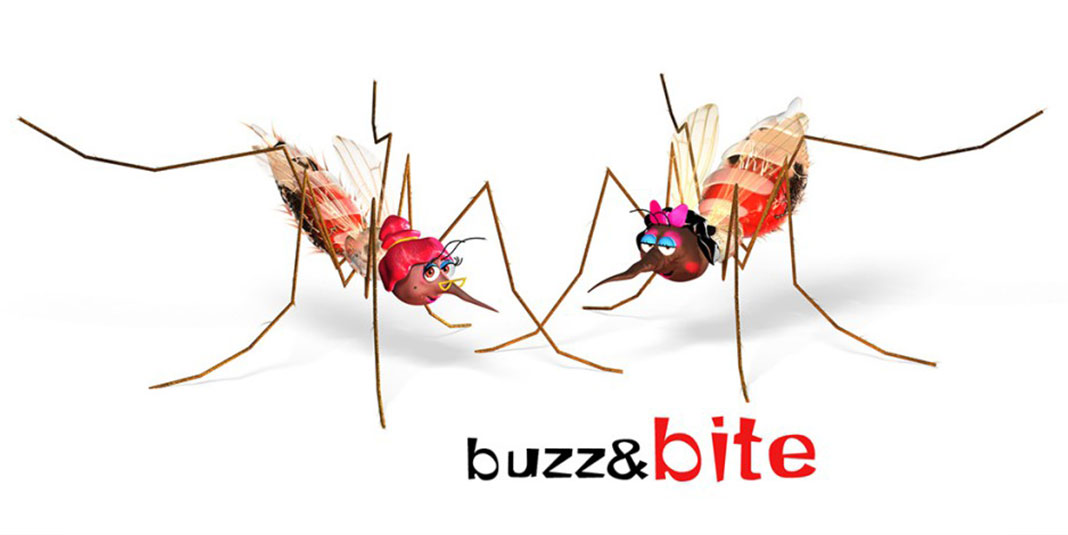
A series of 30 short animated PSAs starring two talking female Anopheles mosquitoes, Buzz and Bite. Instead of portraying malaria primarily through illness and death, the mosquitoes use humour to explain their own method of transmission and how humans can defeat them. Animation allowed the same underlying concept to be culturally and linguistically localized while retaining two recognizable characters.
Languages
The international series was produced in numerous languages, with a particularly important localization in Madagascar: versions were created in all 16 languages of Madagascar — an exceptional example of going beyond a country’s official or dominant languages to reach people in the languages actually used in their communities. (Chocolate Moose Media)
Where used
The campaign has been used in more than 50 countries — approximately half of the world’s malaria-affected countries — through television, health organizations, hospitals, clinics, universities, schools, libraries and community groups. More than 3,000 tapes and DVDs were distributed in addition to broadcast and online use.
Evidence/impact
Its principal documented impact is extraordinary geographic and linguistic penetration for a specialized malaria-prevention communication campaign. It moved from a small Canadian production into use across more than 50 malaria-affected countries, while the Madagascar adaptation demonstrated that sophisticated health communication could be localized even into comparatively small language communities. Independent repositories including TheWaterChannel continue to host the material years after its creation. (The Water Channel)
Archbishop Desmond Tutu strongly supported the campaign, praising its ability to communicate across language and cultural boundaries and its contribution to malaria prevention. (Chocolate Moose Media)
Partners
Funded in part by the Canadian Red Cross and the International Federation of the Red Cross. Worldwide distribution by UNICEF and the Red Cross. UNICEF Madagascar played an important role in the Madagascar language adaptations. The campaign was launched at the United Nations in New York ahead of the first World Malaria Day. Broadcasters, malaria organizations, NGOs, hospitals and community organizations became distribution partners and users; Archbishop Desmond Tutu was a prominent international supporter.
Watch
Download/use rights
Free to broadcasters, NGOs, hospitals, doctors, community organizations, universities, schools, educators and other users worldwide. No licence fee was required for humanitarian or educational distribution. (The Water Channel)